
![Build Topical Authority in AI Search with Query2Vector [Tool]](/static/images/blogs/build-topical-authority-in-ai-search-with-query2vector-tool.jpg)
AI Search
8 Min
Build Topical Authority in AI Search with Query2Vector [Tool]
AI search evaluates topics, not keywords. Upload your search queries and see which topics your audience cares about, ranked by opportunity.
December 01, 2025

Co-Founder

Co-Founder
Contents
Google Search Console contains the raw signal of what your audience searches for, but keyword lists can't reveal intent. AI search engines evaluate content using vectors, not keywords. By converting your search queries into vectors and clustering them by meaning, you can see which topics your audience cares about, where your current authority is strongest, and which gaps to prioritize. Query2Vector is a free tool that transforms your Google Search Console data into vector clusters, revealing the intersection of what your audience is searching for and where your brand has established topical authority. The result is a prioritized view of which topics to invest in, which to improve, and which to deprioritize.
Topical authority wins AI search, not keywords.
Google, AI Overview, AI Mode, ChatGPT, and Perplexity look for brands that demonstrate authority in their core business offering.
Previously, you could compete for keywords far from your area of expertise without damaging your brand authority. One of HubSpot's top performing blog posts of all time is Funny, Clever, Cool: Best Instagram Captions for Life & Business. That has nothing to do with being the best sales CRM. But they cornered a long-tail keyword (Instagram caption writing), and it delivered consistent monthly traffic.
That worked when content marketing was a series of isolated competitions. Guessing worked. Spray-and-pray worked. Finding available keywords disconnected from your business worked. Each keyword was its own game and anyone could win.
AI search connected all those games into a single board. Now you're filling out a map made of topics. Each piece of content you publish claims a square. The goal: connect the territory around your business and audience before your competitors block you. Every move tells search engines what your brand is expert in.
HubSpot's blog, which dominated the old, mini-game-based search, lost over a third of its traffic from November to December 2024 as AI search engines prioritized topical authority. The pages that stopped driving traffic were the ones that shared the least relationship to HubSpot's products and audience.
Ethan Smith, CEO of Graphite, said in his Reforge course: "Topics are the new keywords. And topical authority is the new PageRank."
In a previous article, we demonstrated how vector search works and shared the output in a spreadsheet template. Query2Vector puts the power of vector search in your hands: upload your Google Search Console data and see your topics ranked by opportunity.
How AI Search Measures Topical Authority
AI search doesn't guess which brands to cite. It evaluates your content across three pillars: lexical search (keywords), semantic search (intent), and topical authority (expertise).
Semantic search determines what the user wants. Lexical search handles keyword matching. Topical authority decides which brand has earned the right to answer.
Understanding how these three pillars work together is key to gaining ownership of the topics that matter to your brand and audience.
Pillar 1: Lexical Search (Keywords)
Keyword matching is classic search, and it still plays a specific role in AI search. Keyword matching handles tasks that are hard or time consuming for semantic search: recognizing brand names, anchoring domain-specific language, and matching exact product names.
When a user searches for a solution in your category, lexical search checks whether your brand name appears in relevant content. When they search for your brand directly, it confirms you exist and connects you to the topics you've claimed.
Keywords power query expansion too. When someone types "bike flat tire," the search engine generates related queries (tools, supplies, causes) to build a complete answer. If your content covers the core topic but ignores related entities, you lose ground to competitors who mapped the full territory.
Keywords remain essential throughout AI search, from understanding the question to researching the answer.
As vector database provider Zilliz notes:"Lexical search is often used alongside vector databases to build hybrid systems. While lexical search provides speed and precision for exact text matching, semantic search adds contextual relevance.”
Pillar 2: Semantic Search (Intent)
Semantic search converts text into numbers so AI can measure meaning.
As iPullRank explains in The AI Search Manual: "From an optimization standpoint, semantic search was a tectonic shift. Suddenly, you could be retrieved for queries that never mentioned your exact keywords, as long as your content meant the same thing."
Every query and every piece of content gets transformed into a vector. A vector is a list of numbers that captures what the text means. Those numbers position each query in a mathematical space where similar meanings sit close together.
This is how AI search understands intent without matching exact words. "What's my take home pay" and "salary after taxes" use different words but land near each other in vector space because they mean the same thing. The distance between vectors measures how closely two pieces of content relate.
When you run your Google Search Console data through our tool, you'll see this in action. Queries cluster by meaning, not by keyword. "Texas salary calculator" and "California paycheck calculator" group together. They have no words in common, but their meaning is similar. Their vectors sit close in 256-dimensional space.
This matters for topical authority because AI search engines use the same math. They convert your content into vectors and measure how well it matches the intent behind a query. Content that covers a topic thoroughly produces vectors that cluster tightly around the queries your audience asks.
Pillar 3: Topical Authority (Expertise)
Topical authority means owning a topic, not just ranking for a keyword.
AI search evaluates whether your brand comprehensively covers a topic. Do you answer the full range of questions your audience asks? Does your content demonstrate expertise across the entire subject?
When AI search engines build answers, they pull from sources that demonstrate depth. A brand with one article on payroll taxes gets passed over. A brand with content covering withholding calculations, quarterly deadlines, state requirements, and common errors looks like an expert. Their content forms a dense cluster in vector space, proof they own the topic.
Most brands already know their topics. The challenge is prioritization. Which topics deserve investment now? Which ones can wait? Where do you double down and where do you deprioritize? Drawing these lines requires seeing your topic landscape clearly, understanding where audience demand meets your current authority, and identifying the gaps between where you are and where you need to be.
Graphite's white paper, titled "Study shows that high Topical Authority leads to faster organic search visibility”, found: “When compared with low Topical Authority content, articles with high Topical Authority are: 57% faster at gaining visibility, 62% more likely to get traffic within the first week, and 30% faster at reaching impression milestones.”
Your Google Search Console data already contains the signal. Query2Vector surfaces the structure, showing which topics to prioritize, which to deprioritize, and where to focus next.
Step-by-Step Guide: Map Your Topic Priorities with Query2Vector
Now that you understand how AI search measures brand authority, it's time to integrate it into your workflow.
We built Query2Vector because this is exactly where most teams get stuck. You understand the power of semantic search and vector embeddings, and then you open your keyword tool. The success of your content depends on a semantic understanding of your audience. Your tools should reflect that.
Let's go.
Step 1: Upload Your Google Search Console Data
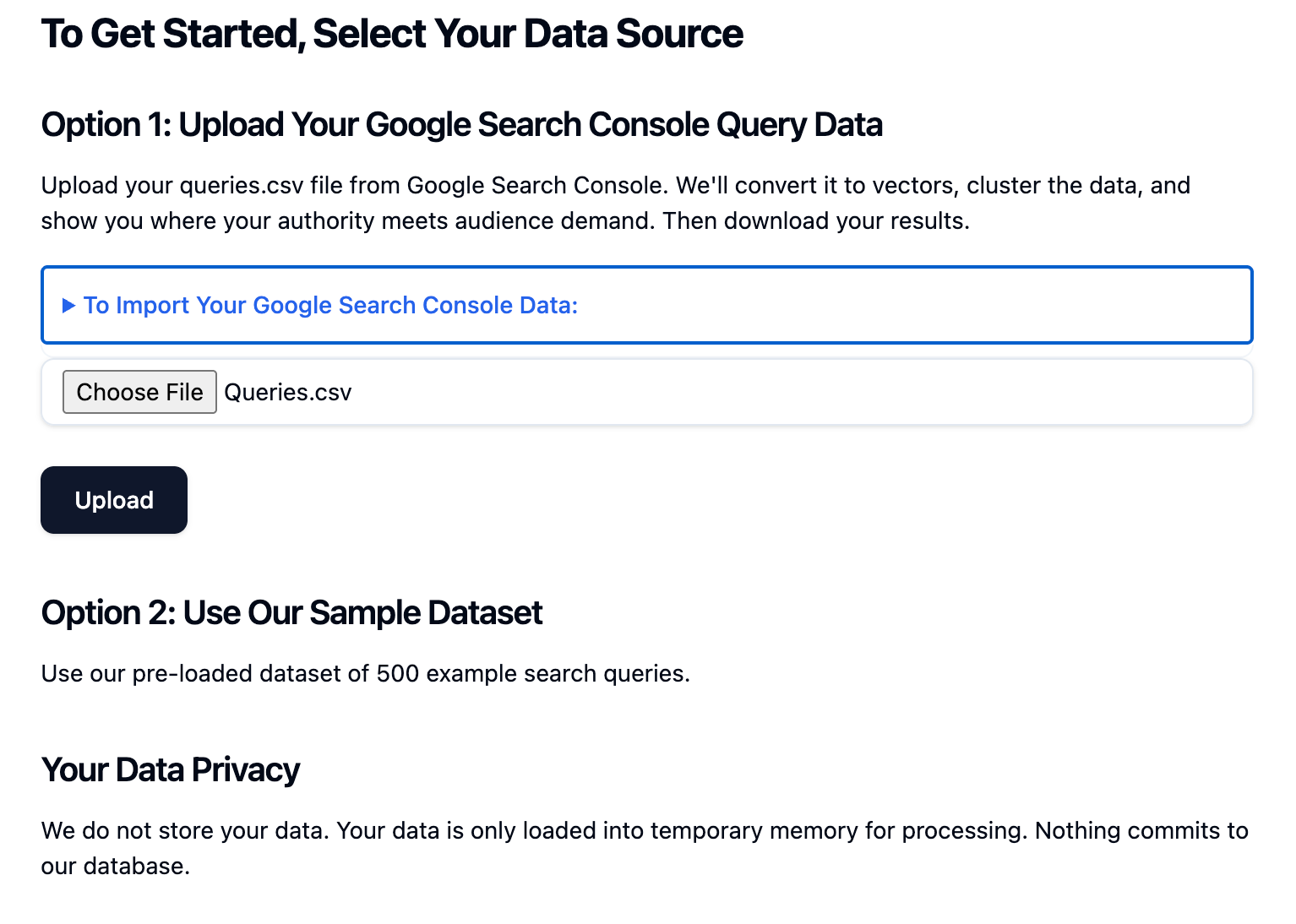
Google Search Console is one of the most valuable datasets available to marketers, and it's free. It logs every search query that led to an impression or click on your site, with exact performance metrics. Query2Vector is powered by Google Search Console data.
To export your queries, navigate to Performance > Search Results in Google Search Console. Filter by your desired date range and export the Queries data as a CSV file.
Upload your queries.csv file to Query2Vector. If you don't have access to Google Search Console data, use our synthetic dataset to see the tool in action. The sample uses an HR platform as the example.
Your data stays private. We do not store anything. Your file loads into temporary memory for processing only.
Step 2: Visualize Your Audience Intent, Not Keywords
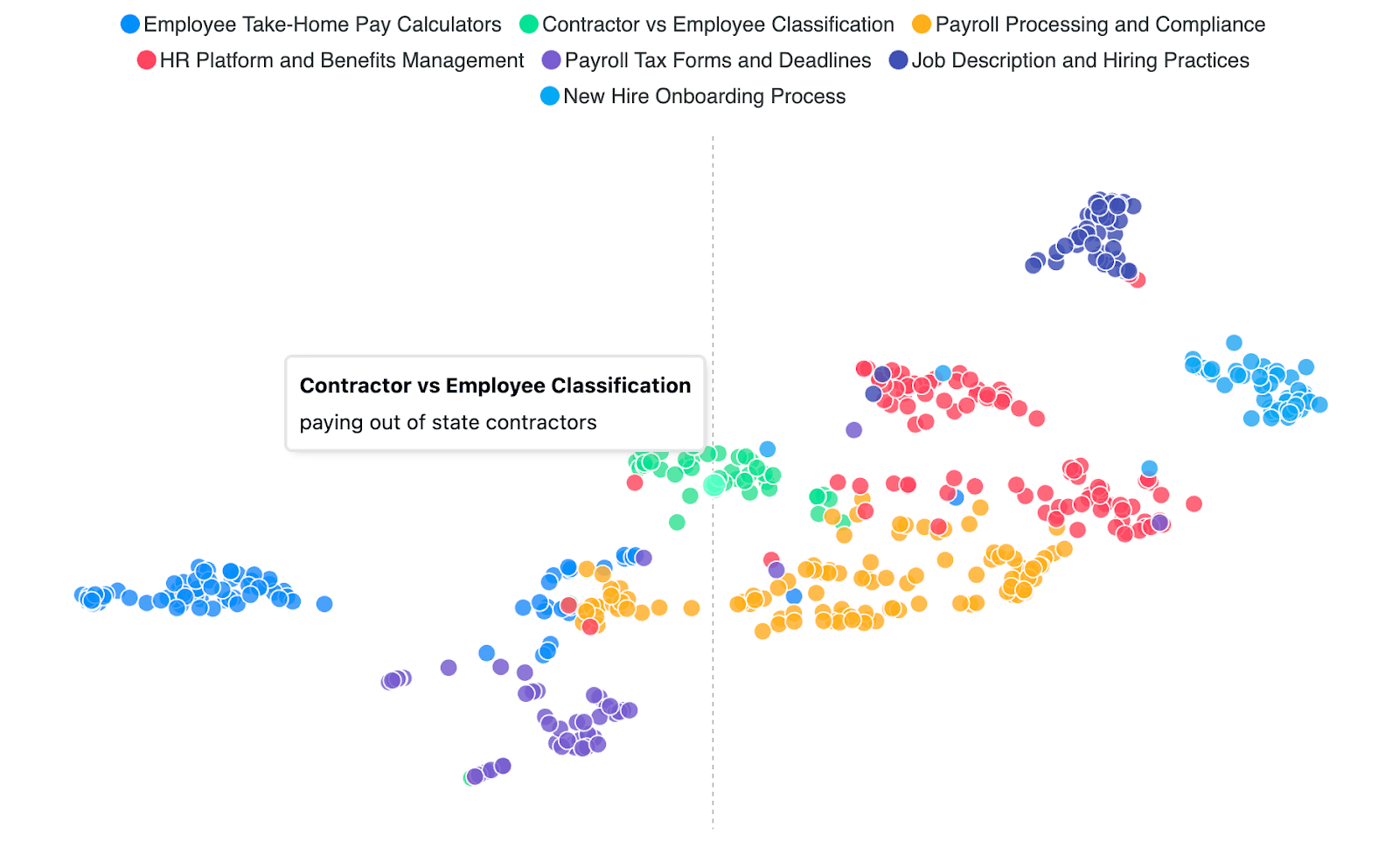
Query2Vector transforms your raw search data into a visual map of audience intent.
Each query gets converted into a 256-dimension vector. Queries with similar meaning cluster together, even when they share no words in common.
This is the power of vectors in action. "What to do when someone joins team" and "first day paperwork for employees" plot next to each other. While they have no keywords in common, they share the same intent. Keyword analysis would place them in separate groupings. Vector analysis reveals they belong together.
Each color represents a topic cluster. Each dot represents a query. Clusters that sit close together share related intent. This is how AI search engines see your audience.
Step 3: Prioritize the Highest Value Topic Clusters
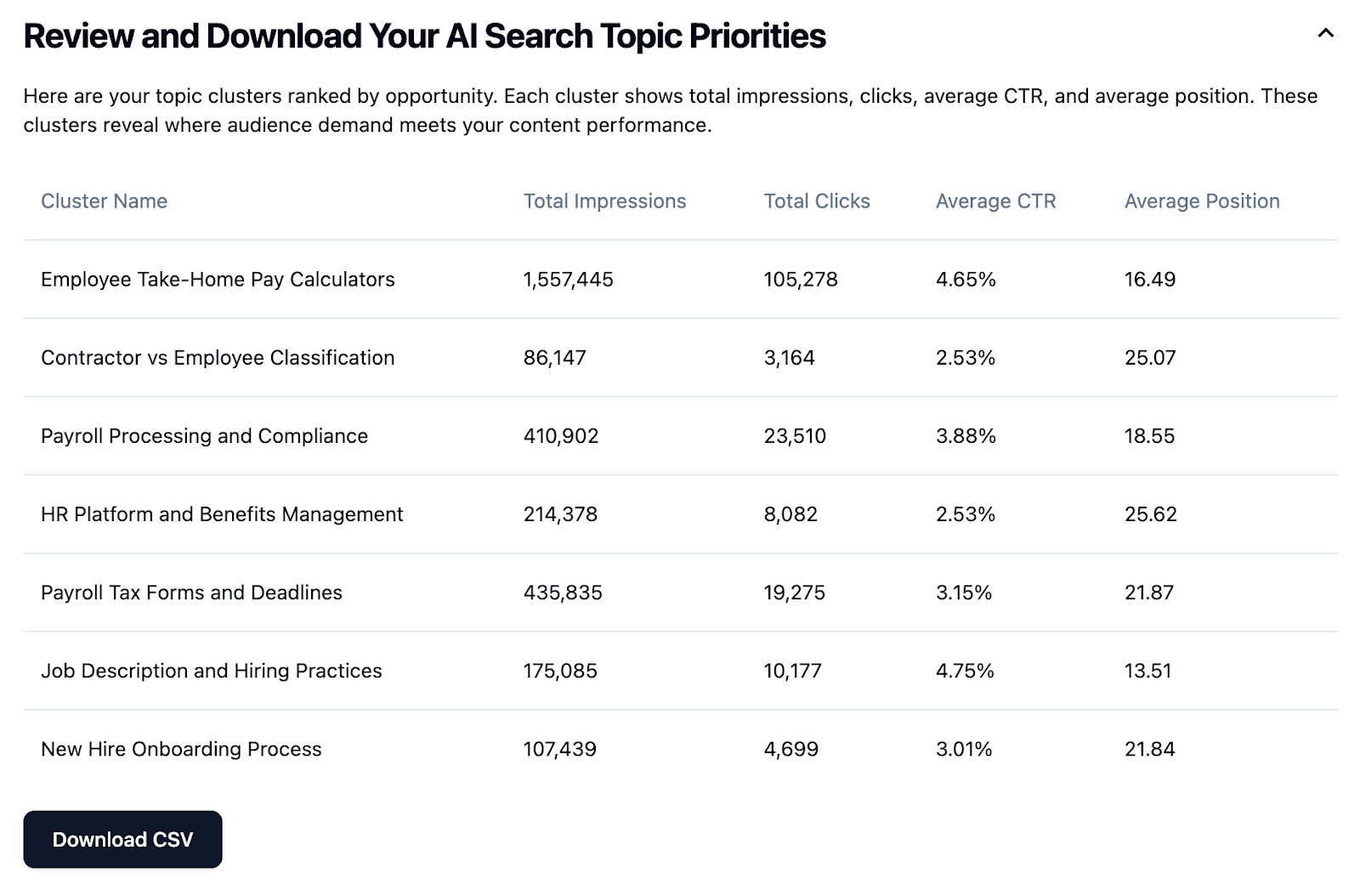
Once you've reviewed the detailed analysis, Query2Vector aggregates performance metrics for every query within each topic cluster, giving you a data-backed view of where to focus.
Key metrics to compare:
-
Impressions: How often someone saw a link to your site on Google.
-
Clicks: How often someone clicked a link from Google to your site.
-
Average Position: Relative ranking of your link on Google (1 is top).
-
Average CTR: Clicks divided by impressions.
High impressions with low clicks signals opportunity: your brand appears but your content doesn't win. Strong position with high CTR reveals existing expertise. Use these patterns to decide which topics to prioritize, which to improve, and which to deprioritize.
Step 4: See How Your Queries Look After Vector Transformation
Want to see what's happening under the hood? Query2Vector shows you the raw vector values for each query.
Earlier in this article, we described a vector as a list of numbers. Each item in that list is called a dimension. Query2Vector uses 256 dimensions to keep the tool lightweight. In our customer-facing AI pipeline, we use 1,536 dimensions for each vector.
These dimensions work together to capture meaning in ways keywords cannot. Queries with similar intent end up with similar numbers and occupy nearby positions in the multi-dimensional space. AI search engines match queries to content by finding the most similar lists.
The table displays the first ten dimensions alongside each query's assigned cluster.
Forecast.ing: B2B Content Briefs for AI Search Visibility
Query2Vector unlocks the semantic intent behind your audience's search queries. This is our free, standalone tool designed to introduce vector analysis into your workflow.
Forecast.ing is our full platform, built for marketing teams who need a steady pipeline of audience insights to power content visibility.
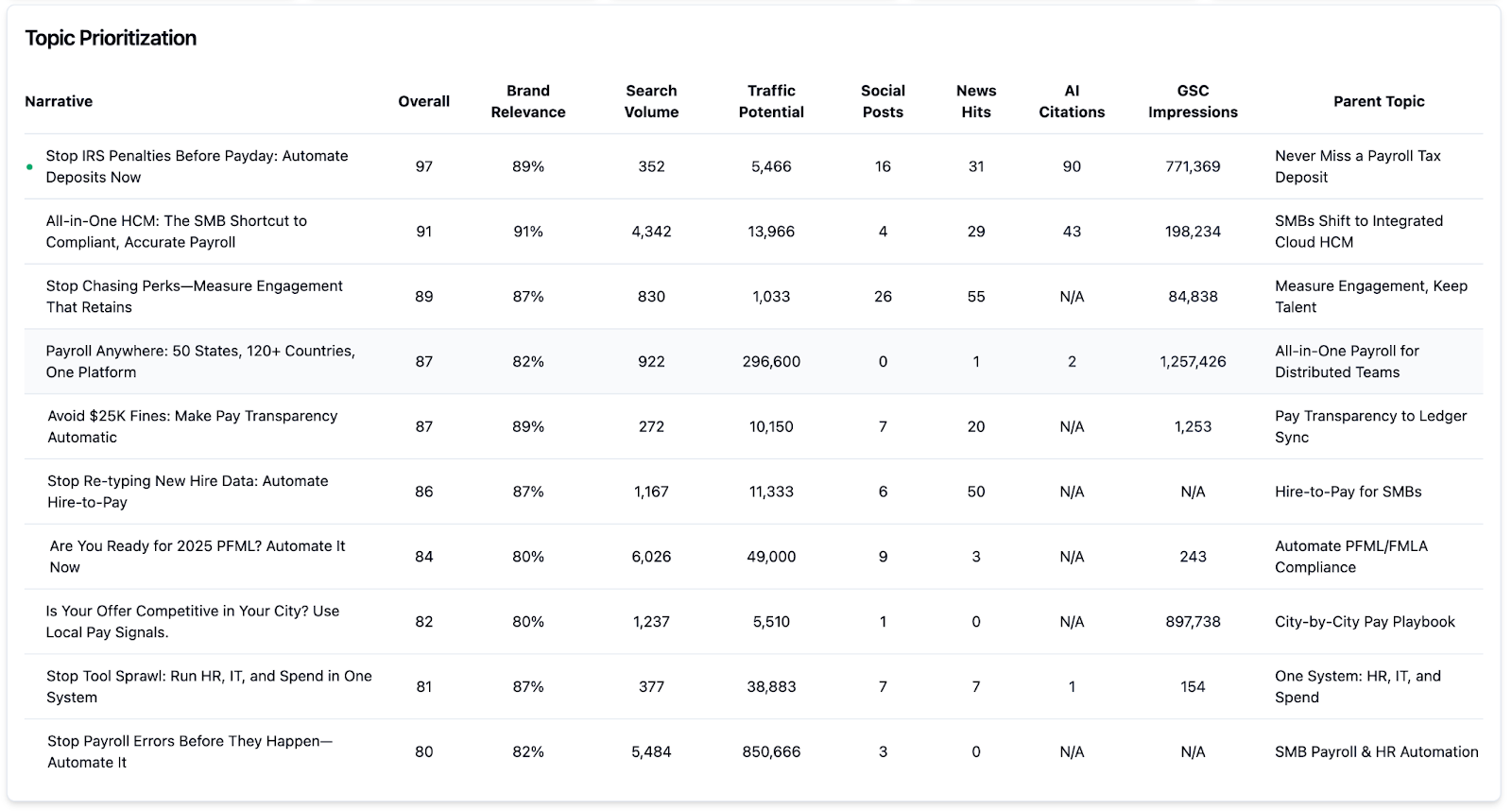
We identify topic opportunities, analyze the competitive landscape, develop a narrative angle, and generate a content brief to jumpstart your writing. This isn't LLM research that summarizes what's already indexed. Forecast.ing runs a custom research pipeline for each client, gathering and processing primary sources specific to your brand, competitors, and market.
The platform pulls from six data sources:
-
Your Public Narrative: Every piece of content you've published that represents your current point of view.
-
Competitive Intelligence: Articles, blogs, product pages, newsletters, and press releases from competitors.
-
Industry Experts: News, reports, and commentary from third-party analysts.
-
Audience Signals: Conversations and discussions from social channels and communities.
-
Search Intelligence: Search volume and traffic potential data for topic ranking.
-
AI Citations: Your brand's attribution rate and citation frequency across Google AI Overview, ChatGPT, and Perplexity.
We vectorize and cluster these signals, rank topics by opportunity, and generate briefs with narrative recommendations and source citations. The full research runs weekly, keeping you aligned with your audience and ahead of your competition.
Start Using Vectors in Your Daily Workflow
AI search has changed. Your content planning process should too.
Keywords still matter. But if that's all you're using, you're missing the shift that's shaping your brand's visibility. See how your audience looks as vectors. Position your brand as the authority on the topics critical to your competitive positioning.
We've taken the vector embedding process and made it free and easy. No cost. No login. No setting up AI pipelines or agents. Just get answers and go create content that AI search engines mention and cite.
Try Query2Vector now.
Questions or feedback? Reach out.
Frequently Asked Questions
Build topical authority by creating comprehensive content around your core business areas. AI search engines evaluate whether your brand demonstrates expertise across an entire subject, not just individual keywords. Brands that cover a topic thoroughly, answering the full range of questions their audience asks, are more likely to appear in AI-generated responses.
AI search engines cite sources that demonstrate depth and expertise. A brand with one article on a topic gets passed over. A brand with content covering multiple angles of the same subject looks like an expert. Create content that forms a dense cluster around your key topics, and AI search engines will recognize your authority and pull from your pages when building answers.
Yes. Keywords still play a specific role in AI search. Lexical search handles tasks that are hard for semantic search: recognizing brand names, anchoring domain-specific language, and matching exact product names. Keywords also power query expansion, helping search engines generate related queries to build complete answers. AI search uses a hybrid model where keywords and semantic search work together.
Start with your Google Search Console data. Export your queries and analyze them by semantic similarity, not just keyword volume. This reveals which topics your audience searches for and where your brand already has authority. Look for clusters of related queries that share the same intent. These clusters represent topics, and topics are what AI search engines evaluate.
Topic selection starts with understanding where audience demand meets your current authority. Identify which topics already connect your brand to your audience through search data. Then prioritize based on opportunity: high impressions with low clicks signals a topic worth investing in, while strong position with high CTR reveals existing expertise to build on. The goal is content at the intersection of what your audience needs and where your brand is differentiated.
You might also like
Browse all articles![How To Increase AI Search Using Google Search Console [Template]](/static/images/blogs/how-to-increase-ai-search-visibility-with-google-search-console-data-free-template.jpg)
AI Search
10 Min
How To Increase AI Search Using Google Search Console [Template]
AI search matches meaning, not keywords. Learn how vector search works and use our free template to analyze your Google Search Console data.

Content Marketing
7 Min
The New Zero-Click Math of Content Marketing
AI search is sending less traffic but better buyers. The brands winning aren't chasing clicks. They're becoming the answer AI search engines cite.